


Navigating Influence
Human experience does not develop in isolation. It emerges within nested, interacting systems, with our participation feeding back into those systems. Agency comes from increasing the capacity to recognise influence & so orient coherently within it.
What Shapes Human Experience?
Human experience takes shape through the ongoing interplay of the Body-Mind, our surroundings, relationships, language, culture & technology. Together, these conditions shape what we notice, how we interpret it, what we value & who we become.
Influence is the continual shaping that occurs through these relationships. It can be felt in the way tiredness colours a conversation, a familiar phrase carries an assumption, or another person’s confidence changes our judgement. It does not require intention or awareness. Our responses become part of the same process. What we say, do, repeat & encourage contributes to the conditions shaping other people’s experience. Patterns form within us, between us & across collective life.
Understanding this process is central to Experience Studies: recognising how we are shaped, how we shape others & where greater awareness and choice become possible. It also provides a basis for understanding what changes as intelligent technologies take a growing role in these relationships.
Influence is therefore not something that occasionally acts upon an otherwise independent mind. It is part of the environment in which minds develop.
Fields of Influence
Each new field adds to rather than replaces what came before. We remain embodied, cultural beings living within designed environments, while increasingly encountering the world through computational systems that can select what we see, respond to how we behave, and generate new representations specifically for us.
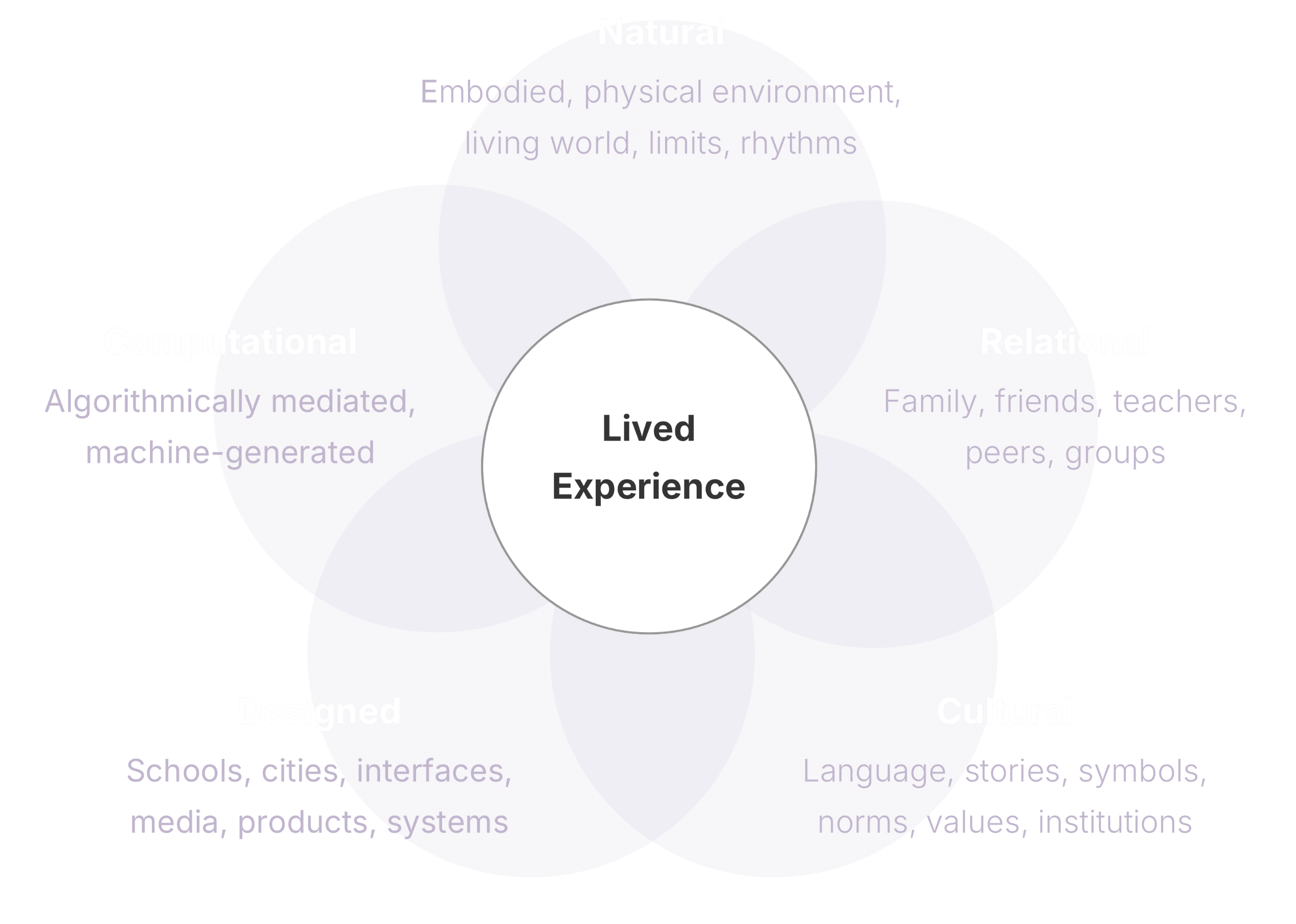
Physiology, sensation, emotion, attention, thought, memory, identity, relationship and culture are active together. Human experience is a living slice through these layers. A change in bodily state can alter interpretation; an interpretation can change behaviour; behaviour can change a relationship.
Consider the following forms of influence:
• A smile can soften tension and change how we receive the following words.
• An advert can connect a product to feelings of belonging, success or a sense of lack.
• A poor night’s sleep can make an ordinary difficulty feel harder to manage.
• A classroom layout can encourage conversation or direct attention to authority.
• A recommendation can bring something into view & so mask other possibilities.
Powers of Influence
Influence works through several capabilities, often in combination. A person, institution or digital system may shape what we encounter, respond to us & change the interaction over time.
• Present — bring something into attention or experience.
• Pre-filter — select what we encounter, what remains unseen & what appears first.
• Adapt — change in response to behaviour, feedback or context.
• Personalise — tailor an encounter to our history, preferences & circumstances.
• Generate — create new material in response to a person or situation.
• Persist — remain present or return repeatedly over time.
• Model — build an understanding or profile of a person from accumulated information.
Their significance depends on who or what is influencing us, whose interests are served, how close the influence comes to our inner lives & whether we can recognise and respond to it. Duration, reach, responsiveness & knowledge of the person all matter.
What we encounter takes on meaning through our bodily state, history & expectations. How we meet it—automatically or with greater awareness—shapes our response. What we then say or do enters our relationships & surroundings, becoming part of the influence shaping others.
The New Architecture of Influence
For most of human history, human development was defined by a single reality: we had to adapt ourselves to the world. We developed our identities, resilience, and understanding of others by encountering an environment that was indifferent to our preferences. We grew by navigating its friction. Today, that developmental environment has fundamentally inverted. We are raising a generation in a world that is designed to adapt to them.
The digital systems mediating our lives have rapidly evolved through four stages:
• Select – Curating choice
• Learn – Tracking behaviour
• Adapts – Mirroring preferences
• Generate – Creating bespoke synthetic content adapted to task
Influence becomes Intimate
Synthetic psychological intimacy is an unprecedented risk, & a major new pressure on human development. These systems sit between us and reality, shaping, nudging, & steering our relationships, culture, and increasingly, our inner life. When the environment seamlessly anticipates and generates our desires, influence stops being something we can easily observe or resist. It becomes responsive, invisible, and deeply interwoven with human experience itself.
Synthetic influence is becoming increasingly intimate, responsive & interwoven with experience itself.